In 2015, the United Nations General Assembly chose 5 November as World Tsunami Awareness Day to promote a culture of preparedness.
Rather than memorialising recent tragedies like 11 March or 26 December, Japan proposed 5 November to commemorate Inamura no Hi - The Fire of Rice Sheaves.
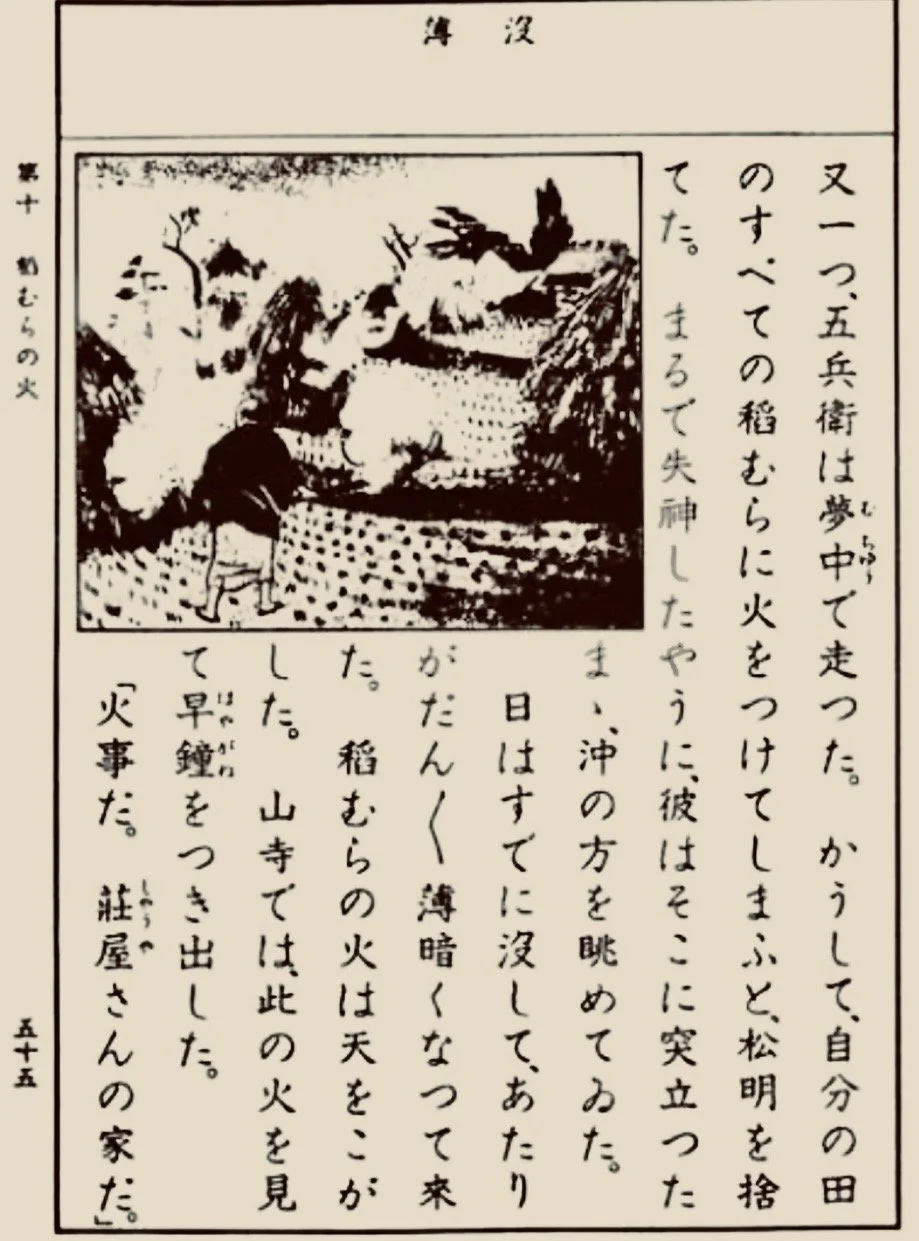
Hamaguchi Goryo protected his village of Hiro (present day Hirokawa, Wakayama Prefecture) from a tsunami after the 1854 Nankai earthquake by burning his rice crop as a signal to warn villagers of approaching calamity.
On his way to a festival, so the story goes, Hamaguchi felt an earthquake and remembered elders telling him that, “after an earthquake comes a tsunami.” He looked out to sea at the receding ocean drawing itself up into a terrifying wave in the distance.
Hamaguchi lit a torch, rushing to warn everyone. Knowing he would never make it in time, he set fire to piles of rice sheaves. Villagers saw the fire, and running to put it out came across Hamaguchi yelling:
“A tsunami is coming - head for high ground!”
As people climbed to safety in the mountains, a tsunami engulfed the entire village. Fortunately, everyone survived. The same event claimed around 3,000 lives elsewhere in Japan at the time. Afterwards, Hamaguchi mobilised survivors to build a seawall to protect the village, which again saved countless lives after the 1946 Nankai earthquake.
Inamura no Hi - The Fire of Rice Sheaves – and World Tsunami Awareness Day represent a potent reminder that in the face of disaster, action and preparedness can save lives.
For those who saw the devastation of the 2004 Indian Ocean tsunami, with 230,000 lives lost and millions displaced, these lessons carry great significance. Behind the statistics are stories of families and survivors left to rebuild their lives.
The Diplomat is a novel shaped by my experience of such events. It remembers lives forever changed and the survival stories that stay with us long after headlines fade.
Coastal communities are particularly vulnerable to tsunamis. Cooperation, early warning systems, education, and preparedness are key factors in reducing risks from future events.
#TsunamiDay #GetToHighGround