Nāga Spirits
Bangkok, Thailand
25 December 2004
Austronesian-speaking tribes who inhabit the coast and islands in the Andaman Sea on Thailand’s west coast, the Moken people, are familiar with the language and behaviour of the sea. An old man heeds the cacophony of silence, warning others of approaching peril. Seventy people in his group listen and escape to safety, but the wave drowns everyone else.
“Tides and light change. The sky sends a message. Sea levels forebode danger. Dolphins dive for deep water. We know the signs of the tsunami. Everything is still before the cataclysm. Then it strikes.”
“The Great Wave is a sea serpent, a Nāga,” he says. He has not eaten for a long time.
“He is hungry. He wants to dine on delicious human flesh.”
A tsunami is more than a wave. It’s an aggressive spirit conceived in nightmarish depths. An anthropomorphic force gestating in the fecund uterus of the Earth. Tsunami, like storms, have bodies, fierce protruding eyes, gnashing teeth, and a terrifying tail, like the Nāga.
Conceived from a primordial union of fire and water, the beginning of a tsunami permeates multiple dimensions, like the birth of the planet, aeons ago. After the fireball cools, its aromatic vapours attract the gods. Over time these deities become Nāga spirits and humans, progenitors of kings and queens. A violent earthquake or volcano, a landslide or a meteoric explosion can give birth to a mighty tsunami, an event that changes everything forever. It is a cataclysmic birth that forces the sea and land together and then tears them apart.
A quake in the seafloor triggers a permanent rise in global sea levels. The sea recedes into a gaping pit, surging back with the gravitational energy of Heaven and Hell combined. Tsunami and earthquakes offer balance, equilibrium. As tectonic plates collide, earthquakes relieve pressure like steam from a kettle. If such energy does not escape, the planet might tear itself asunder, like an apple ripped apart at the core.
Earthquakes are a kind of episiotomy, a tender cut in the Earth’s fabric, releasing a divine manifestation of energy. As the cataclysm jolts along trenches deep below the oceans, displacing hundreds of cubic kilometres of water, the liquid mass surges from its epicentre as a series of pulsing waves travelling over 800 km an hour, faster than most aeroplanes can fly.
As an event, a tsunami is supernatural in scale and its assault unpredictable. Sea and sky are both calm before the cataclysm, and then the apocalyptic force arrives without warning. The assailant offers barely minutes for people to scramble to higher ground. Thousands of people don’t make it. And afterwards, the waiting and the worrying.
Thousands of aftershocks heralding doom and fear.
Will there be another?
What happens next? What should we do?
Where can we go? Whom can we ask for help?
—
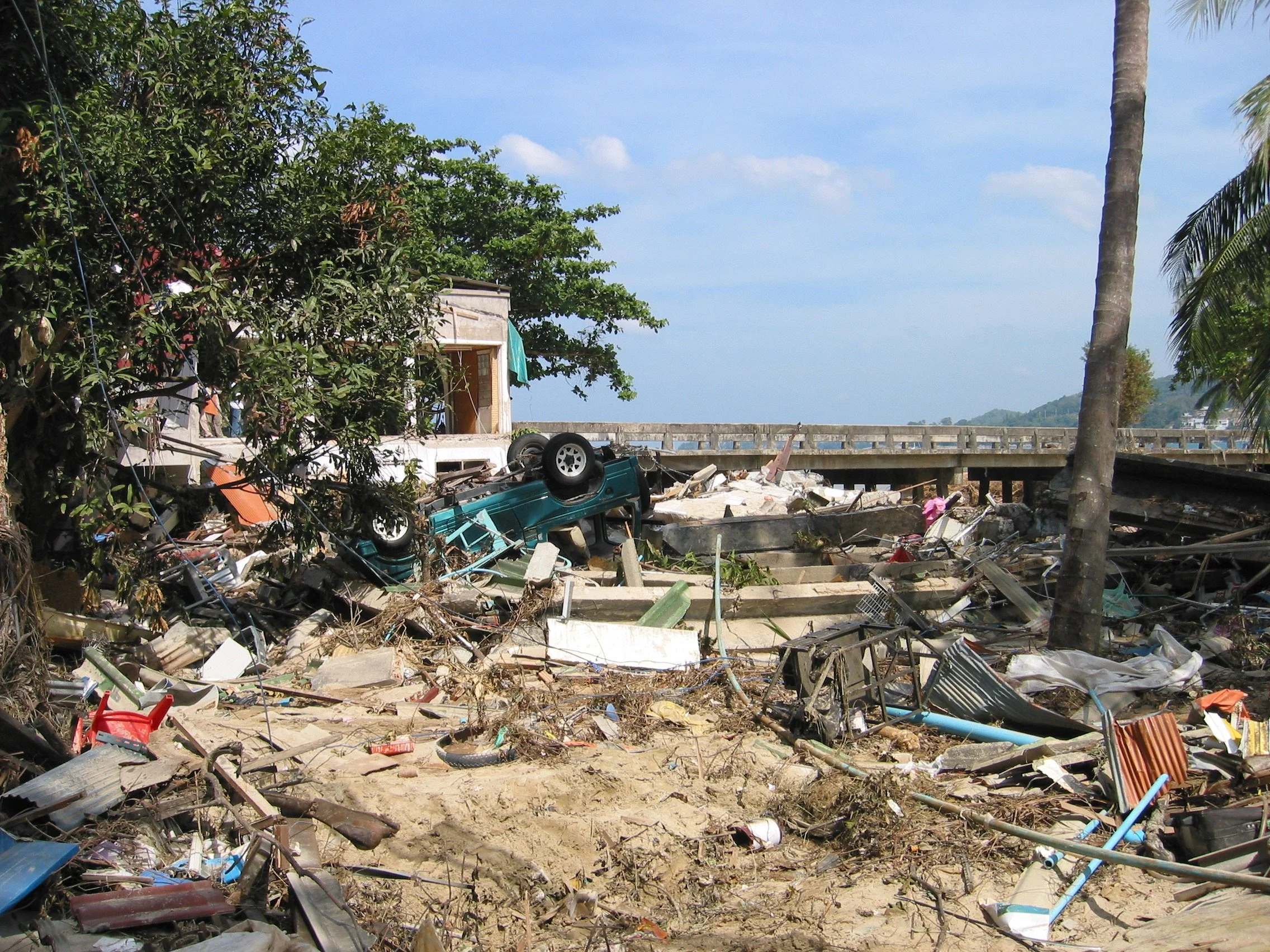
At 07:58:53 local time, 30 km beneath the sea off the northern coast of Sumatra, Indonesia, a magnitude 9.1 earthquake ruptures 1200 km of the Sunda megathrust, propagating north towards the Andaman Islands. It is the largest earthquake ever recorded. Sudden displacement of the seabed generates a tsunami in the Indian Ocean, with waves reaching 50 metres, higher than a ten-storey building. An impenetrable wall of water.
The volume of energy it thrusts is equal to 23,000 times the Little Boy atomic bomb dropped on Hiroshima in 1945. Waves fan across six continents, reaching out their long arms towards Indonesia, to India, Sri Lanka, Africa. They pulverise Thailand’s coastline within 90 minutes, washing across islands, purging coastal settlements, separating families, leaving villages without food, shelter or clothing. Angry Nāga spirits devour everything in their path.
—
The Diplomat ponders the devastation. Tsunami and other disasters prove that nature is not an external entity controlled by humans. But he can’t really imagine the impact. It seems distant and unreal to him, like something in a faraway dream. Something unreal.
Are earthquakes and tsunami a supernatural reckoning of some kind, a lesson to humanity? But no, he doesn’t really believe in divine retribution. Everyone is just trying to get on with their lives, especially in Thailand, where life is perilously fragile. Just surviving.
According to Mali, Nāga represent underworld deities. As creation spirits, these water serpents wield divine power. She once told him that Nāga represent immortality, fertility and infinity.
“They have the power to give life and take it away.”
“If humans disturb a Nāga’s lair, revenge is swift.“
The Diplomat imagines these creatures, the Nāga, moving through a sea of rocks, causing friction and fire underwater. Flashes of red and gold, images of writhing deities, half-human, half-serpent.
Cosmic phenomena decide our fate, the movement of planets and other powerful forces. Humanity seems small and insignificant in the face of such immense things.
Our destiny, our fate, is in our hands, but only up to a point. We decide how we treat other people. Those actions and consequences have an impact on our future, and on the generations that follow, but our lives are just a drop in the infinite ocean of time, Mali says.